Best MCP Server Testing Tools: Protocol, OAuth & Agent Evals
A Model Context Protocol (MCP) server can pass its unit tests and still fail in a release. The OAuth flow can break on a newer client, a client can render the tool result differently, or an agent can call the wrong tool. Each failure sits in a different layer: protocol, authorization, client compatibility, or agent behavior.
Choosing a testing tool starts with the failure layer you need to cover. This comparison looks at MCP Inspector, MCPJam, mcp-eval (LastMile AI), Braintrust, and DeepEval across protocol and OAuth checks, client compatibility, regression and CI, and agent evaluation.
TL;DR
- MCP Inspector is suited to interactive protocol and OAuth debugging plus targeted CLI checks. MCPJam covers pre-production protocol testing, OAuth debugging, client-configuration testing, model-in-the-loop evals, and CI release gates.
- mcp-eval from LastMile AI lets Python developers write agent-driven tests against real MCP servers and assert on OpenTelemetry traces. Braintrust connects agent evals with CI and production observability. DeepEval provides MCP-specific and broader LLM evaluation metrics.
- Protocol, transport, authorization, and client-compatibility checks should run before agent-quality evaluation. They test different failure modes.
- Teams supporting the 2026-07-28 MCP revision should test its stateless request model separately from legacy revisions that start with the
initializehandshake.
What should MCP server testing tools cover?
An MCP testing stack should cover the layers that can block a release: protocol and transport behavior, authorization, client compatibility, pre-production regression, and agent evaluation. Protocol checks determine whether the integration works correctly. Agent evaluations determine whether an agent uses that integration correctly.
For the 2026-07-28 MCP revision, servers must implement server/discover, which returns the server's supported versions, capabilities, and identity. Clients are not required to call it: a client can send any request directly and handle an UnsupportedProtocolVersionError, so test both paths. Streamable HTTP requests carry routing headers: MCP-Protocol-Version and Mcp-Method on every request, plus Mcp-Name for tools/call, resources/read, and prompts/get. A server must reject a request whose required headers are missing or do not match the body with a 400 HeaderMismatch error.
Older MCP revisions use a different connection model. The 2026-07-28 revision removes the initialize/initialized opening and Mcp-Session-Id from its modern protocol path. Servers that support older clients should test those legacy paths separately rather than assuming one successful session covers both protocol eras.
Authorization tests should cover protected-resource and authorization-server discovery, issuer validation, Client ID Metadata Documents (CIMD), pre-registration, token exchange, denied or expired authorization, and legacy registration paths when required. The 2026-07-28 authorization specification deprecates Dynamic Client Registration (DCR), in which a client registers itself with the authorization server at runtime, and retains it for backward compatibility with authorization servers that do not support CIMD.
Client compatibility needs its own testing layer. Different AI clients can vary in MCP Apps rendering, tool-result image handling, and display behavior. MCPJam's client compatibility catalog tracks 16 clients across these constraints.
Agent evaluation comes after the integration checks. It can measure tool selection, argument construction, execution paths, task completion, output quality, and final application state. A successful MCP response does not prove that an agent chose the correct tool or that a write operation changed the intended system of record.
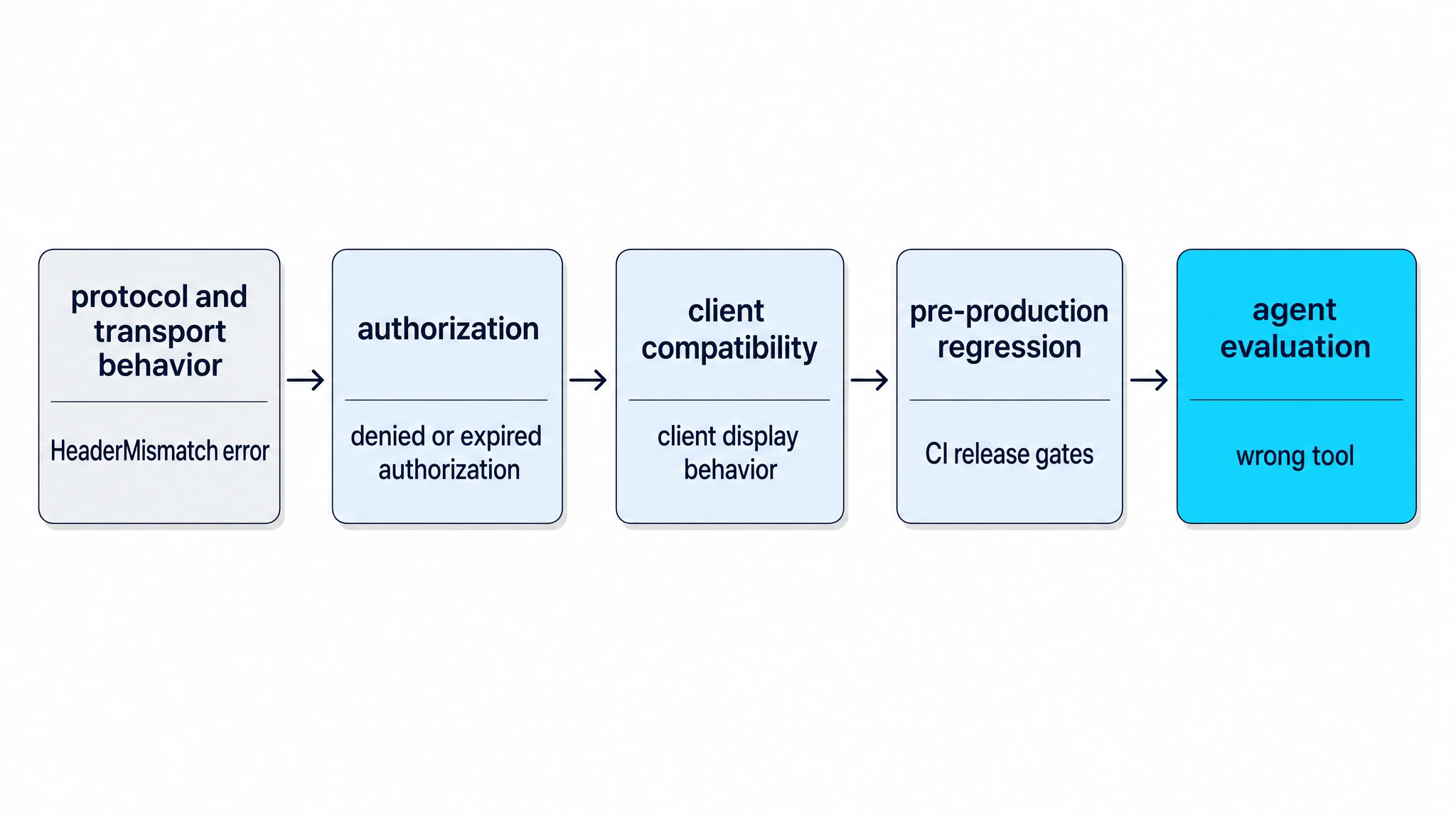
Each testing layer catches a different failure, from protocol and transport behavior to agent evaluation.
MCP server testing tools compared by workflow layer
| Product | Choose when | Primary testing layer | Protocol and authorization | Client compatibility | Regression, CI, or eval workflow |
|---|---|---|---|---|---|
| MCPJam | You need protocol, OAuth, client-compatibility, and model-in-the-loop eval gates before release | MCP reliability testing | Protocol-version testing and guided OAuth flows | 16-client compatibility catalog | Conformance suites, model-in-the-loop evals with eval gate thresholds, and JUnit XML |
| MCP Inspector | You need interactive protocol or OAuth debugging and targeted scripted checks | Protocol and authorization debugging | Legacy, auto, and modern protocol modes plus OAuth tooling | Acts as the reference MCP client; does not reproduce other clients' behavior | Single-request CLI checks with stable exit codes |
| mcp-eval (LastMile AI) | You need Python tests that run an agent against a real MCP server and assert on the trace | Behavioral evaluation | Focuses on agent-server execution rather than a protocol-conformance matrix | Exercises the configured MCP server through a test agent | Test suites, trace assertions, and CI workflows |
| Braintrust | You need agent evals in pull-request CI and production | Agent evaluation and observability | MCP evals sit above protocol-level tests | Evaluates instrumented agent behavior | Datasets, experiments, traces, online scoring, and bt eval |
| DeepEval | You need MCP-use scoring alongside LLM and RAG metrics | LLM and MCP-use evaluation | MCP workflow focuses on application interactions and task scoring | Evaluates recorded MCP interactions | Python evaluation tests with MCP-specific metrics |
How to choose an MCP server testing tool
Choose the tool based on the failure you are trying to catch. Protocol and client tools answer whether an MCP integration can communicate correctly. Agent-evaluation tools answer whether model-controlled behavior produces the intended result after that integration works. MCPJam covers both groups.
MCP protocol and transport validation
MCP Inspector and MCPJam both test protocol behavior, but their workflows differ. Inspector exposes legacy, auto, and modern protocol modes. Legacy remains the default, while modern pins the 2026-07-28 revision.
MCPJam's automatic protocol mode probes server/discover over HTTP or stdio and falls back to legacy initialization when the server requires an older protocol path.
OAuth and authorization debugging
MCP Inspector covers the authorization flow, including authorization-server discovery, pre-registration, DCR, CIMD, enterprise-managed identity, token exchange, reauthorization, and step-up behavior.
MCPJam provides a guided OAuth debugger for multiple protocol and registration paths. Its OAuth conformance suite can run registration methods, protocol versions, and authorization modes from a repeatable CLI workflow. A separate XAA debugger exercises Cross-App Access flows.
Client and runtime compatibility coverage
MCPJam publishes a 16-client compatibility catalog and a cross-client testing workflow covering clients such as Claude, ChatGPT, Cursor, Copilot, and Codex.
Inspector provides a reference client for protocol inspection, while mcp-eval, Braintrust, and DeepEval focus primarily on agent or application execution.
Regression testing and CI release gates
The CI workflow differs by product. MCP Inspector supports scripted requests with stable exit codes. MCPJam runs protocol and OAuth conformance suites and emits JUnit XML for CI reporting. Its eval gate sets the exit code from a pass/fail policy with configurable thresholds and baseline comparison.
mcp-eval supports CI-oriented behavioral suites and trace assertions. Braintrust can run evaluation files through bt eval, while DeepEval executes MCP evaluation cases through its Python workflow.
How MCP agent evaluation tools differ
MCPJam, mcp-eval, Braintrust, and DeepEval all test behavior above the wire-protocol layer.
They differ in where the agent run comes from and what decides pass or fail.
| Tool | Where the agent run comes from | What decides pass or fail |
|---|---|---|
| mcp-eval | A test agent it runs against your server | Python tests that assert on the OpenTelemetry trace: tool calls, execution order, latency, cost, and returned content |
| Braintrust | Agent runs your code instruments, including production traffic | Scorers over versioned datasets and live traffic; experiments compare results |
| DeepEval | Interactions your application records | MCP-specific metrics for tool use and task completion |
| MCPJam | A real model it runs against your server under a chosen client configuration | Expected tool selection and arguments; the eval gate passes or fails the CI job |
MCPJam for pre-production MCP reliability testing
Best for
Teams that need repeatable checks across MCP protocol behavior, OAuth flows, client compatibility, model-in-the-loop tool-selection evals, and CI before a release reaches production.
What it is
MCPJam is an MCP testing platform with an open-source local core, real-model playgrounds, OAuth debugging, cross-client testing, and automated evaluation workflows. MCPJam Inspector, its local app, is a different project from MCP Inspector. Paid plans add higher usage limits and team-oriented capabilities around the testing workflow.
Where it fits in MCP server testing
For client compatibility, MCPJam maintains a 16-client directory that records constraints such as MCP Apps rendering, image-result support, and client display behavior. Each client profile bundles a model, system prompt, attached servers, protocol settings, and MCP App sandbox controls, so a test reproduces how a specific client behaves.
For authorization, the guided OAuth debugger covers modern and legacy protocol paths plus pre-registration, DCR, and CIMD. The XAA debugger covers Cross-App Access separately.
For agent behavior, MCPJam evals are repeatable behavioral tests: they run a real model against your server and check whether it selects the expected tools with the expected arguments, reporting accuracy, latency, and token use.
For automation, the MCPJam CLI runs server health checks, protocol and OAuth conformance suites, and an eval gate that sets a verdict-based exit code from configurable thresholds and baseline comparison. The CI workflow supports JUnit XML output and includes GitHub Actions and GitLab CI examples.
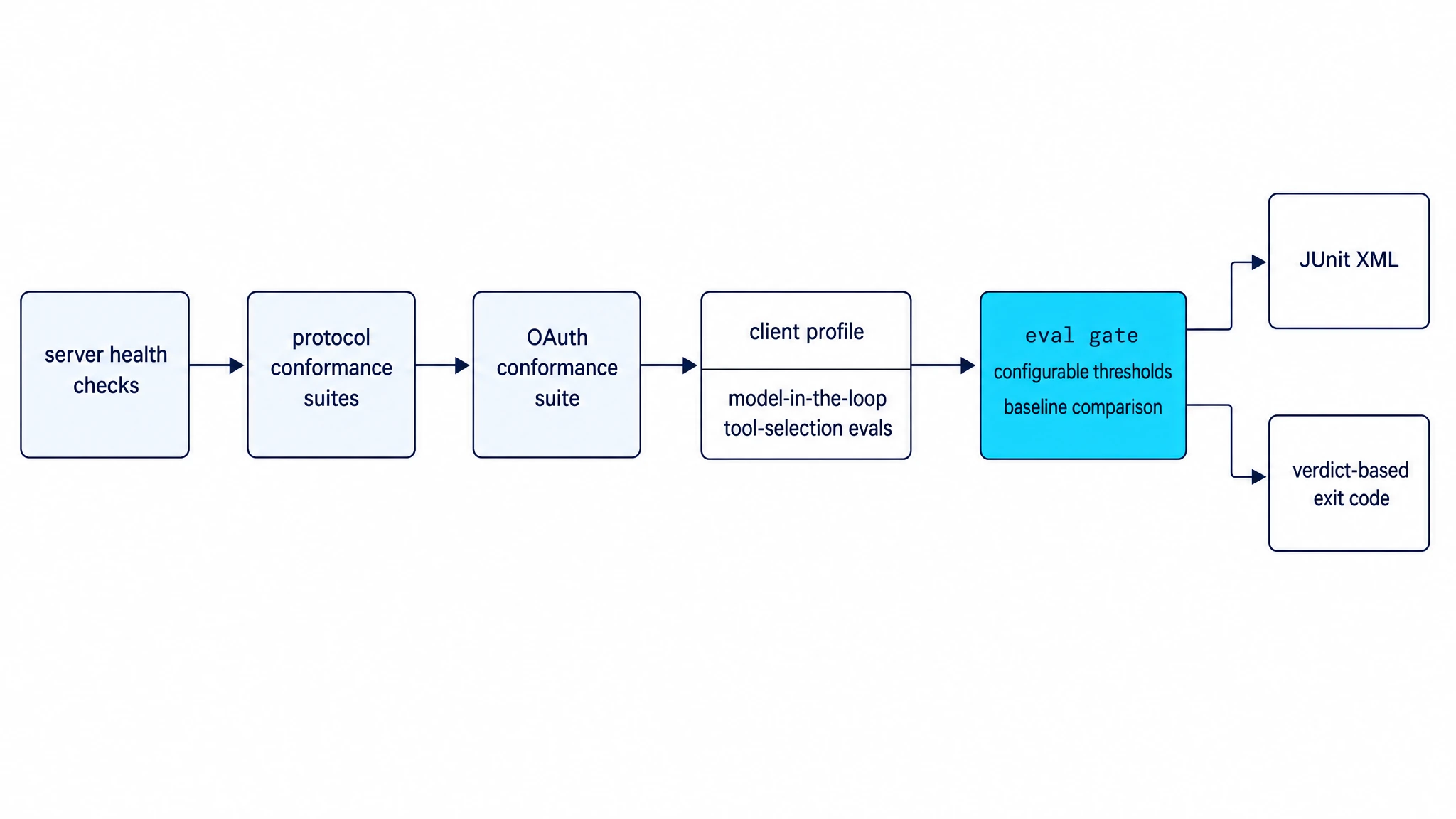
A CI release gate can run health checks, conformance suites, and model-in-the-loop evals, then report through JUnit XML and a verdict-based exit code.
The OAuth conformance flags require --url, --protocol-version, and --registration. Headless auth mode requires an authorization server that auto-consents, so run it against a test authorization server, not production.
Tradeoffs and limits
MCPJam does not instrument production traffic. Teams that need continuous production trace analysis should pair it with an agent-observability system.
Pricing
MCPJam pricing lists Free at $0 per month with 200 credits per day and unlimited seats and projects. Pro is $24 per month billed annually, or $288 per year, with 5,000 credits per month. Team is $199 per month billed annually, or $2,388 per year, with 50,000 credits per month and basic RBAC.
Enterprise pricing is custom and adds advanced RBAC, SSO, and audit retention and logs. Every plan includes the Playground, OAuth Debugger, Evals, User Testing, Swarm, and CI/CD checks. Free keeps 30 days of trace history, while paid plans keep unlimited history. Pro and Team can buy additional credits at $10 and $9 per 1,000 credits, respectively.
MCP Inspector for protocol and OAuth debugging
Best for
Developers who need direct protocol inspection, interactive OAuth debugging, or targeted command-line checks during development and CI.
What it is
MCP Inspector is the open-source developer tool from the Model Context Protocol project. It provides web, CLI, and TUI clients for inspecting MCP servers.
Where it fits in MCP server testing
Inspector can inspect tools, resources, prompts, JSON-RPC traffic, and authorization behavior.
Inspector requires Node.js 22.19.0 or newer. Modern mode pins MCP 2026-07-28, while auto mode probes the newer protocol behavior and can fall back to an older server.
Tradeoffs and limits
Each CLI run sends the single request named by --method, and Inspector documents no model-in-the-loop evaluation or scored behavioral release gate. A passing tools/call shows that the server responds, not that a model will choose the tool.
The CLI exit codes include 0 for success, 3 when authentication is required, 4 for an unreachable server, and 5 for a tool error or unknown tool, so a CI step can branch on the failure class. Inspector stores OAuth tokens in ~/.mcp-inspector/storage/oauth.json, so treat that file as a credential in CI.
Pricing
MCP Inspector is free and open source and can run through npx @modelcontextprotocol/inspector.
mcp-eval by LastMile AI for code-oriented MCP behavior tests
Best for
Python developers who want to write tests that run an agent against their MCP server and assert on the execution trace.
What it is
mcp-eval is an open-source evaluation framework from LastMile AI. It runs real agent-server interactions and derives assertions from OpenTelemetry traces.
Where it fits in MCP server testing
Use mcp-eval when a test needs to check tool calls, call order, returned content, latency, cost, or an execution path. Test authoring is Python-oriented, while the target MCP server can be implemented in another language.
Its documentation focuses on agent-driven behavioral testing rather than presenting a protocol-version or OAuth-conformance matrix. Run it alongside protocol and client-compatibility testing; it does not replace those checks.
Tradeoffs and limits
mcp-eval adds an agent to the test path, so failures can come from model behavior as well as the MCP server. That is useful when you want to test real agent execution, but protocol failures should still be isolated with a lower-level protocol tool.
Pricing
The mcp-eval repository is open source under the Apache 2.0 license.
Braintrust for agent evals in CI and production
Best for
Teams that need agent evaluations in pull-request CI and production, with datasets, experiments, traces, and online scoring in one managed workflow.
What it is
Braintrust is an AI evaluation and observability platform for measuring agent and application behavior.
Where it fits in MCP server testing
Braintrust can run MCP evals before merge and score production traffic after release. Its workflow connects datasets, experiments, traces, regression thresholds, and instrumented tool trajectories.
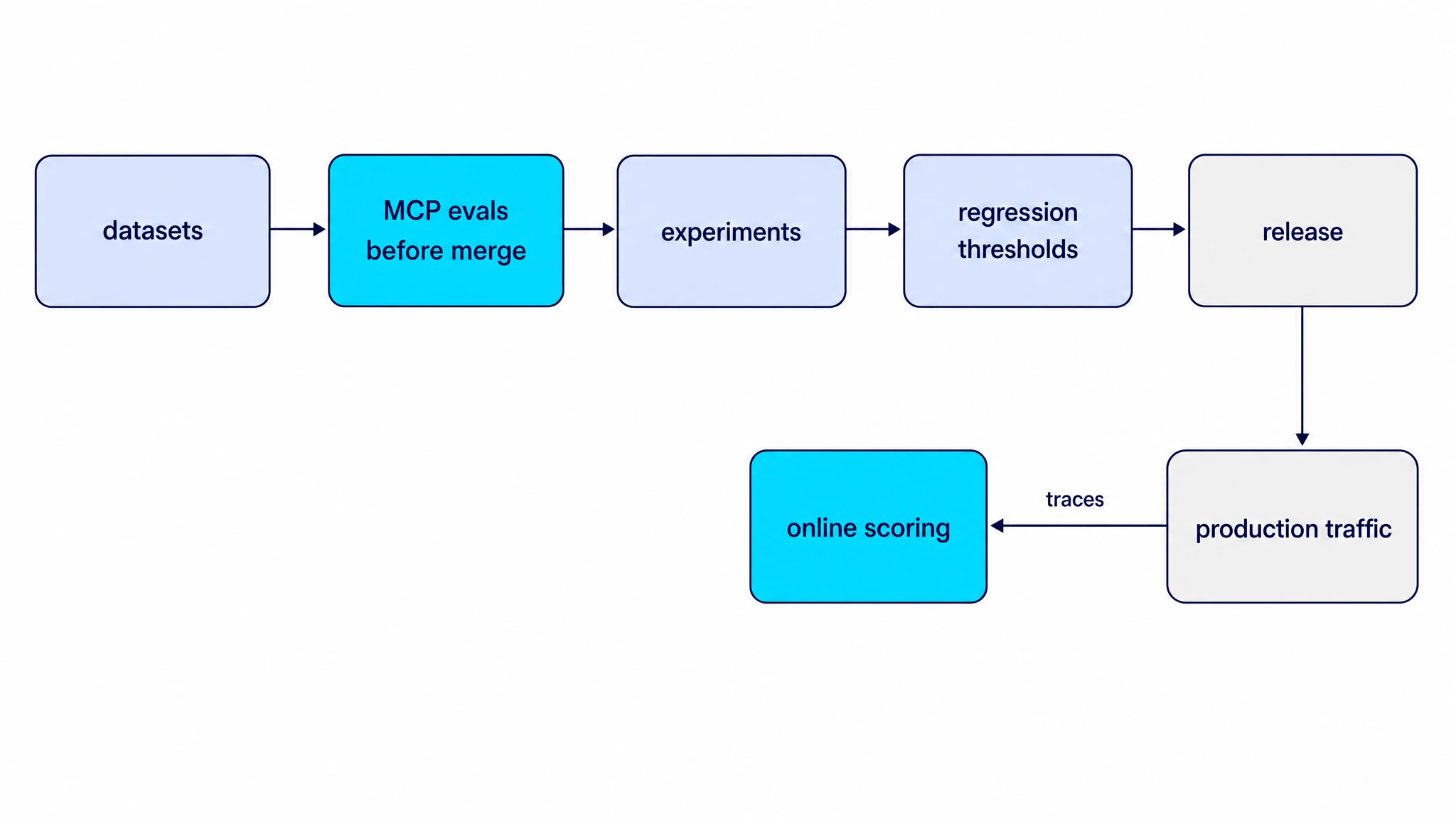
Braintrust runs MCP evals before merge and scores production traffic after release.
The bt eval command runs evaluation files from CI. Use it when the release decision depends on agent-controlled tool choice, argument quality, task completion, or final-state behavior.
Tradeoffs and limits
Braintrust's MCP testing workflow operates at the agent and application layer. Protocol transport, authorization, and client-specific compatibility still need separate checks when those failure modes matter to the release.
Pricing
Braintrust pricing lists Starter at $0 per month with 1 GB of processed data, 10,000 scores, and 14-day retention. Pro is $249 per month with 5 GB of processed data, 50,000 scores, and 30-day retention.
After the included usage, Starter charges $4 per GB of processed data and $2.50 per 1,000 scores. Pro charges $3 per GB and $1.50 per 1,000 scores. Enterprise pricing is custom.
DeepEval for MCP-use metrics and LLM evaluation pipelines
Best for
Teams that want MCP-use scoring alongside LLM-as-judge, RAG, safety, and other application-evaluation metrics in Python.
What it is
DeepEval is an open-source LLM evaluation framework with predefined metrics and a Python test workflow.
Where it fits in MCP server testing
DeepEval provides MCP-specific evaluation metrics, including MCPUseMetric, MultiTurnMCPUseMetric, and MCPTaskCompletionMetric.
MCPUseMetric scores primitive usage and argument generation for a test case. MCPTaskCompletionMetric evaluates whether the agent completed the requested task across a conversation. Applications record MCP interactions and build evaluation cases from those executions.
Tradeoffs and limits
DeepEval's MCP documentation concentrates on MCP-use and task scoring. Teams that also need protocol-version, routing-header, transport, or OAuth-conformance checks should run those at a lower testing layer.
Pricing
DeepEval is open source under Apache 2.0. Confident AI, its optional hosted platform, has a Free plan at $0 with two seats, one project, and five test runs per week.
Starter costs $200 per month with unlimited seats, up to five projects, and 5 GB-months of trace spans. Additional trace volume costs $1 per GB-month.
Conclusion
Start by mapping the protocol revisions, transports, authorization paths, and AI clients your MCP server must support. Test those integration boundaries before relying on agent-quality metrics. For write tools, verify the system of record after the call instead of treating a successful MCP response as proof that the intended state changed.
Then turn those checks into repeatable CI gates and add agent evaluation where model-controlled execution affects the result. Teams that need protocol, OAuth, client-compatibility, and tool-selection checks before release can start with MCPJam's MCP testing workflow.
FAQ
What is the best MCP server testing tool overall?
No single product covers every testing layer. MCP Inspector addresses protocol and authorization workflows. MCPJam addresses protocol, authorization, client-configuration, and model-in-the-loop eval workflows before release. mcp-eval, Braintrust, and DeepEval test agent or application behavior, and Braintrust also scores production traffic. The right combination depends on whether you need integration correctness, client compatibility, agent-quality evaluation, or several of these layers.
When should I use MCPJam for MCP server testing?
Use MCPJam when you need repeatable pre-production checks across protocol behavior, OAuth, client compatibility, tool-selection evals, and CI. It is especially useful when the same MCP server must work across multiple AI clients before release.
When is MCP Inspector enough?
MCP Inspector is enough when the immediate task is interactive protocol or OAuth debugging, inspecting MCP traffic, or running a targeted scripted request from CI. It does not cover whether a model selects the right tool or how a server behaves across client configurations.
Can Braintrust or DeepEval replace MCP protocol testing?
No for the workflows covered here. Braintrust evaluates agent behavior through evals and traces, while DeepEval scores MCP usage and task completion. Protocol versions, routing behavior, transports, and authorization still need dedicated integration tests.
Do current MCP servers need legacy initialization tests?
Only when the server must support protocol revisions that use the older handshake. For MCP 2026-07-28, test server/discover and the stateless request model. Test initialize, version negotiation, and session behavior separately for older revisions you continue to support.
How does mcp-eval (LastMile AI) differ from MCPJam?
mcp-eval and MCPJam both run a model against a real MCP server and check tool calls. mcp-eval defines tests in Python and asserts on OpenTelemetry traces. MCPJam adds OAuth debugging, protocol conformance suites, and client-configuration testing, run through its CLI, SDK, and hosted platform. Teams can use both when they want code-first trace assertions plus client and OAuth coverage.